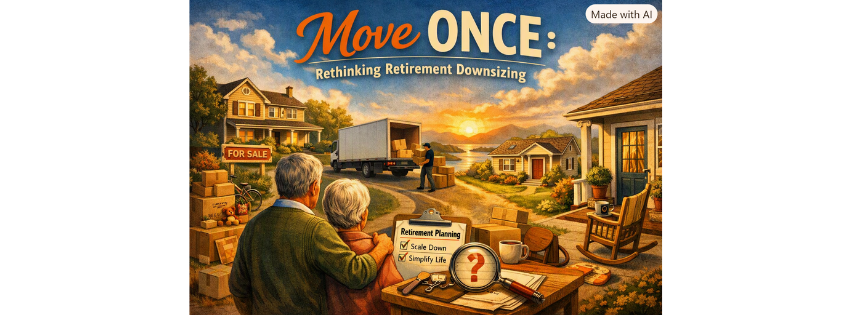
Move Once: Rethinking Retirement Downsizing

I have had this conversation with a few of you this year, others in the past and no doubt will do with some of you in the future. The phrase I use is ‘Move Once’.

My thoughts here make no judgement or opinion on those who have or will do differently. And as usual, there are variables for other folk too. However, if this move is still to happen in your life, think on it.

It’s about when we get to that stage where you’ve been in that same, lovely, old-school house for 30 years, with a door to the kitchen and a separate entrance hall so that you can sneak to your room without the guest in the lounge seeing you. But now the kids have left, retirement has snuck up on you, and it’s time to think about moving and downscaling. You might be in your early sixties, and you don’t believe you’re old enough to move into a retirement living / complex space yet. So, you move now, and then you might have to move again in your seventies or eighties.

The truth is that we are, ready to move in our sixties to that retirement living space. Where the care will be there for us without moving again. We avoid another stressful time of buying and selling and transfer fees and throwing away more of the 30 years of stuff you brought with you on the first move. Our health will be weaker later. It won’t seem so easy when 10 years older.

Move once.
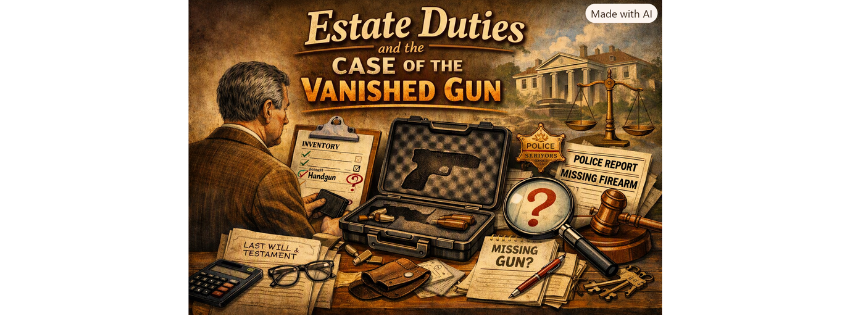
Estate Duties and the Case of the Vanished Gun

Later today I am going to a police station to report a missing firearm in an estate, of which I am the executor.

Not the late owner’s fault; the firearm was handed in to a legitimate dealer for repairs, but this dealer went bust plus was doing some shady stuff. There are others that went missing too. There’s a case with the police about it all. But I, as executor, am responsible for a firearm in an estate. Wonderful.

I have learnt from the professional executors who help me with my estates, that, when a firearm owner passes away and I am the executor, it is my responsibility to ensure that any firearms have been moved to a place that is registered and licenced to store firearms. And if not, there’s a possibility of a case of negligence against me. Getting better all the time! Learning all this over the past year, has made me decide to check carefully that I am aware of whether you own firearms and that there are plans in place for them.

Something to think on here… if you own firearms and don’t use them or haven’t for years and years and might never again, sell them. It will be helpful for your estate. If there is no-one to inherit them, then the estate can simply sell them. If whoever you have nominated to inherit your firearms wants them – yes, check with them first – then they need to be prepared to apply for and get a firearm licence as soon as possible when you pass away. Plus they need to be prepared to buy a proper gun safe. But in both cases, I’m still supposed to ensure they’re moved to legal storage in the meantime.

These are just my thoughts for what is potentially the most frightening – not necessarily the most frustrating or time consuming; I can list those for you – but frightening, item in an estate.

So, if no-one hears from me all weekend, I’m in a police cell waiting for the magistrate on Monday morning for the bail hearing because I’m in trouble for not reporting a missing firearm close enough to the date of death.

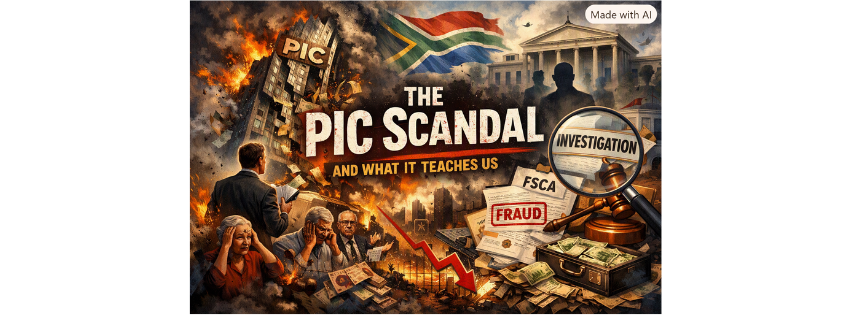
The PIC Scandal and What It Teaches Us

The Financial Sector Conduct Authority, a body that I also have to give stuff to and report to, has started investigating the Public Investment Corporation. There are a few articles in the news about this.

The PIC is a state-owned investment organisation. It manages a lot of money, more than any other asset manager in the country, made up of public servant’s pension funds.

In short, the PIC has made some poor investment decisions and lost a couple of billion Rands, because companies invested in have collapsed and gone into business rescue. These companies are unlisted companies, meaning they are not listed on the stock market, where controls over companies are better. Investing in unlisted, private companies, has also brought the question to the FSCA as to whether individuals benefitted from some of these private investments.

The thing is, that the people running the investment side of things, the people playing the investment managers, are just human beings. There might be a committee, there might be just a small group of individuals, but they are just other human beings. This group of human beings could be different, could be another group of employed people.

Our investments are not run by some big building with a fancy name and entrance hall and waiting room with a nice coffee machine. They are run by ordinary humans who somehow got the job. I know that the managers of the funds I use for you and me, are different to the above. Why? I hear, learn and sense the ethics at play when talking to them or visiting their offices, plus these managers do not invest in private companies, plus unit trust funds have independent Trustees overseeing the compliance, plus every individual manager has to have some of his/her own money in the funds they manage. Brings ownership.

My opinion, firstly, is that investment managers of these sorts of funds should not be allowed to invest in private, unlisted companies. Subject closed. Secondly, no investment management company should be owned by a government.

The Lists You’re Glad Not to Be On

Fun fact:
Every one of you reading this will be pleased to know that you’re neither an international nor a domestic terrorist—and none of you has improper relations with politicians.
We have to—well, I have to—check every new client, and then check each of you again once a year, to make sure that you do not appear on the international list of terrorists. I also receive an email whenever someone is added to—or removed from—the list globally. The names are generally hard to pronounce: vowels and consonants arranged in ways we’re not used to speaking.
We must also check, by either knowing or asking our clients, if you are a Domestically Politically Exposed Prominent person. (DPEP) Or an associate thereof.
It’s all a bit much.
One of my rude friends reading this will want to know if I’ve been checked against that international list. And yes, Jacki has to look for me too.

Prevention is Power: Why Check-Ups Matter

I did my annual medical check-up near the end of last month. All things ok. My doc then sent me for a carotid artery scan the week after, because I had had a brief vision blur moment the week before. Tells me our carotids won’t be clear if we have tiny clots or bad stuff going on elsewhere. But all clear.

This month I also do my next dermatologist check-up. That mole and skin looking over thing. My next colonoscopy is in 8 years’ time, I think. My heart gets monitored every night. A cardiologist showed me last month how to read the printouts from the Heart Centre. It showed that without my pacemaker, I would be at a resting heart rate of 26. A not-alive thing.

I had my annual optometrist check-up in May too, following the vision blur episode. Looked into my soul…. Hopefully I was on a good day. I’ve learnt from her (the optometrist) over the years, how the blood vessels in our eyes talk about our health.

Ticking all the medical check-up boxes.

As usual, most of my aim of talking about the above is to highlight the need for all this and to nag you to go if you’re due. Prevention and/or early detection is so much better.

So book and go.

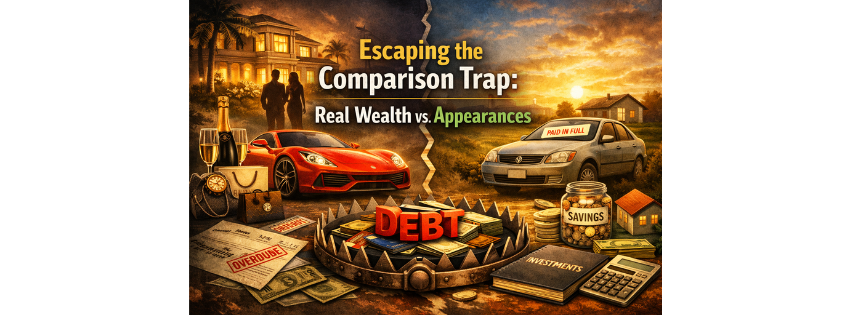
Escaping the Comparison Trap: Real Wealth vs. Appearances

For fun today, let’s have a look at what car you could buy if you only have R150,000. In cash. Because you must change your view of buying cars to being only what you can pay cash for.
I have written of this before and found another journalist who wrote about it last week. He called it ‘the comparison trap’. About people adjusting their spending based on what’s happening around them in society and their social circles. With a desire to keep up.
One area where this is very prominent is the desire for a car that you shouldn’t buy, with the excuse that you must buy a new one – or almost new – for the maintenance plan or the safety features when it’s often really about looking cool and showing the ability to buy it. I would bet that most cars on the road under 4 or 5 years old still belong to the bank.
So, what if all you had in cash was R150,000. I looked on Auto Trader this week and went straight for one of the best cars in the world: Toyota Corolla Quest. I found a 2018 model in Sandton with 134,000 km on it for R149,900. This car will last another 300,000 kilometres. It will be more reliable all the way than many newer cars, has enough safety features and will cost you less on maintenance and insurance. It’s all most people need. And if you don’t have R150,000 there is one for R85,000 with 270,000km. It will last another 200,000km.
Am I writing about cars today? No, but I should a bit more one day, because they’re a wealth trap.
I am writing about the danger of material wealth being a dangerous non-verbal way of communicating achievement. To remember that real wealth is not about the items other people can see, but rather in the quiet accumulation of savings and investments that provide you with options in the future.

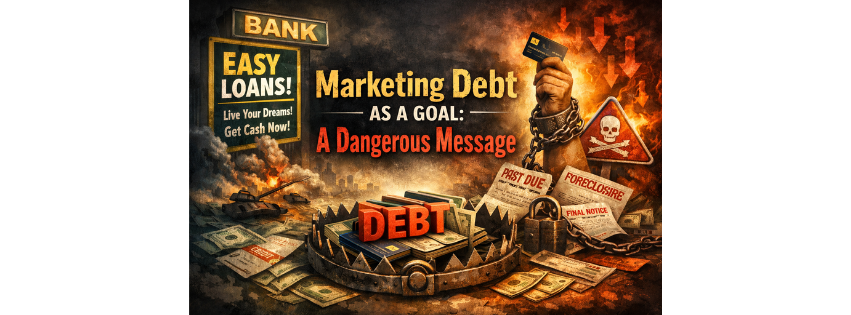
Marketing Debt as a Goal: A Dangerous Message

I recently received a message from my bank (better not say what colour bank) telling me that I have available funds in my home loan account that I could use to reach some of my ‘financial goals’. Borrow more and reach your goals. It’s telling me.
Then I noticed similar messages from the other colour bank I use, telling me that I may qualify for a personal loan of R300,000 or a credit card with a R90,000 limit.
I think putting these sort of messages in front of consumers should not be allowed. Yes, a bank makes most of its money by lending money. And so maybe that’s marketing and selling. Like a supermarket advertising, whose worst lines are ‘spend and save’. But this is different. Putting a message in front of a consumer to borrow more money might not be helpful.
It is very good for those with property bonds to put in extra each month and reduce it faster, but not with the purpose of withdrawing and spending again. The only other reason to use available funds from your access bond, should be as an emergency fund. Although from what people are accessing their retirement savings for, emergency means different things to different people.
Encourage yourself, encourage your children, encourage your friend, not to access their bonds. Not take to take out short term loans. Not to use funds like this for a new car or a holiday or painting their house.

Investing Through Turbulent Times

For those of you who looked at your investment values at the end of March and didn’t like the returns for the end of the first quarter of this year, since then, many values have already increased again. Anything between 4 and 6-odd percent in two weeks. Values are not yet back to ‘pre-war’ numbers, but nothing we can control. The ups and the downs in the Middle East are not over. Mind you….. they’ve been there for thousands of years.
I ran the numbers for one client, showing how his additional investment that went in, in late March, bought more assets for him because of values being down than it would have bought for him if values hadn’t been down. More assets means you own more units in the fund; not that your investment is worth more. I said to the client: ‘you bought 103,500 units, instead of 95,840 units at the last pre-war price. I would rather have 103,000 assets than 95,000 assets.’ This is what times of depressed values bring to your money going in. We need them.
Anyway, at least the other side of the moon was quiet.

Investing Through Uncertainty: Perspectives on Conflict, Markets, and Resilience

There could be an expectation for comments on ‘The War’. It must always be remembered that there are many far worse off in the zones than us worrying about our investment values having reduced by 1 to 12%.

As I’ve said before, besides the fact that we can’t do much about this, price reduction is not a problem if you don’t need the value of your investment right now. Meaning you don’t need to take money out. It becomes a good time to put money in, because assets are cheaper. It’s good for our retirement annuity debit order this month and next month and maybe the next too, or for your excess income reinvesting and buying more units than it would have.

But inflation will hit us. The oil price is something we can’t get away from. $110 today. Interestingly, listening to one asset manager speaking this week, he mentioned that the ‘Futures’ price of Oil for 12 months is $75.00. This means, if you want to buy oil today, to be delivered in 12 months time, it costs $75.00 per barrel right now. Meaning markets don’t expect the price to be where it is for too long.

However, there is an uncertainty around the conflict that is obviously not nice, and no one knows how long it will go on for.

Sad that man has to fight so much. That some men have to be evil. That there is so much intentional unkindness.

Wealth, Humanity, and the View from the Road

I was in Cape Town for a couple of days this week. Seeing a few of you. If you drive anywhere in and around the Western Cape Peninsula, one cannot help seeing, at close quarters, what we call ‘squatter’ housing. Khayelitsha, Mitchell’s plain. Others. I drove for a number of kilometres right alongside these folk’s homes. In some places there is no space left for a single shack to fit in between the others….. for hundreds of meters in any direction. That’s how densely they are laid out. That’s the desperation of people to live somehow, somewhere. There is hardly space to walk between the shacks. Where is their water. Where are their toilets.

I think we need to redefine wealth. It’s a relative thing. I am going to say that you are extremely wealthy, if, you have a flushing toilet, indoors. If you have a separate room for this toilet, which includes a bath or shower and a basin. If you have hot and cold running water, indoors. If you have a place to prepare and eat food, with a fridge to preserve this food, and safe electricity to cook it. If you have a small garden for your dog and / or child to play in. If you are able to lock a door at night to keep your child safe.

There is a powerful Oscar acceptance speech given by Angelina Jolie a while back:

“I have never understood, why some people are lucky enough, to be born with the chance that I had, to have this path in life, and why across the world, there’s a woman just like me, with the same abilities and the same desires, same work ethic and love for her family, who would most likely make better films and better speeches….. only she sits in a refugee camp, and she has no voice. She worries about what her children will eat, how to keep them safe, and if they’ll ever be allowed to return home. I don’t know why this is my life and that’s hers…..”